“For all enquiry and all learning is but recollection.”
— Plato, Meno
“We conclude that these states of knowledge are neither innate in a determinate form, nor developed from other higher states of knowledge, but from sense-perception.”
— Aristotle, Posterior Analytics

Ideas are made of Knowledge. But Where What is Knowledge Made of?
Where does knowledge come from? Does it enter through the senses, arise through reason, or emerge from an interaction between the world and the mind? Do we discover knowledge, create it, recollect it, or construct it from materials supplied by experience? These questions belong to epistemology: the study of knowledge, justification, and the limits of human understanding. Yet they also concern everyday life, because every decision rests upon assumptions about what can be known and what counts as evidence.
This can be difficult to see, since knowledge often hides in plain sight. Once an abstract idea has become a technology, institution, or procedure, we encounter its practical descendant rather than the philosophy behind it. A randomized medical trial embodies the distinction between correlation and causation. A court asking whether an injury would have occurred “but for” someone’s action employs counterfactual reasoning. A performance score assumes that certain measurable quantities represent success. The technological children of knowledge also appear as inanimate objects in our environment and, having no voice—with perhaps one modern exception—are easily taken for granted. Abstract ideas do not remain abstract: they become tools, customs, incentives, classifications, and rules by which people are treated and societies organized.
The central difficulty is distinguishing real patterns from imagined ones. Apophenia is the perception of meaningful connections where none exists: interpreting unrelated news stories as a conspiracy, a mountain on Mars as a human face, or a dog-shaped cloud as a sign that all dogs go to heaven. It includes the countless private revelations of aspiring prophets and Nobel-seekers whose supposed discoveries eventually dissolve into coincidence. In statistical language, apophenia resembles a false positive: the declaration that something has been found when nothing was there to find.
Epiphany, by contrast, is the discovery of a pattern that survives examination: Turing patterns, recurring spirals and symmetries, the principle of least action, or the regular ways in which nature produces waves, dunes, stripes, and branching forms under similar conditions. It resembles a true positive: something has been found because something was indeed there.
Yet apophenia and epiphany do not arrive wearing different uniforms. At the moment of discovery, they may feel identical. Both offer the exhilaration of finding order in confusion. Together they tile the uncertain floor of human pattern-recognition; the difficulty lies in knowing whether one stands above buried treasure or a trapdoor. Their difference becomes visible only through criticism, comparison, repetition, experiment, and time.
This leads to causality. To call one thing a cause is to claim that it helps explain another. If a medicine caused a recovery, we prescribe it again. If a policy caused unemployment, we may repeal it. Yet sequence alone does not establish causation. The rooster crows before sunrise without summoning the sun, and umbrellas accompany rain without producing it. The world presents correlations; the mind must determine which deserve the stronger name of cause.
The history of epistemology can therefore be read as a history of attempts to distinguish epiphany from apophenia.
The Birth of the Realist Camp, and the World-Oriented Tradition
Raphael’s School of Athens presents Plato pointing upward and Aristotle gesturing toward the earth. The image captures a genuine difference, but both philosophers believed that reality possessed an intelligible order. Their disagreement concerned where that order should be found.
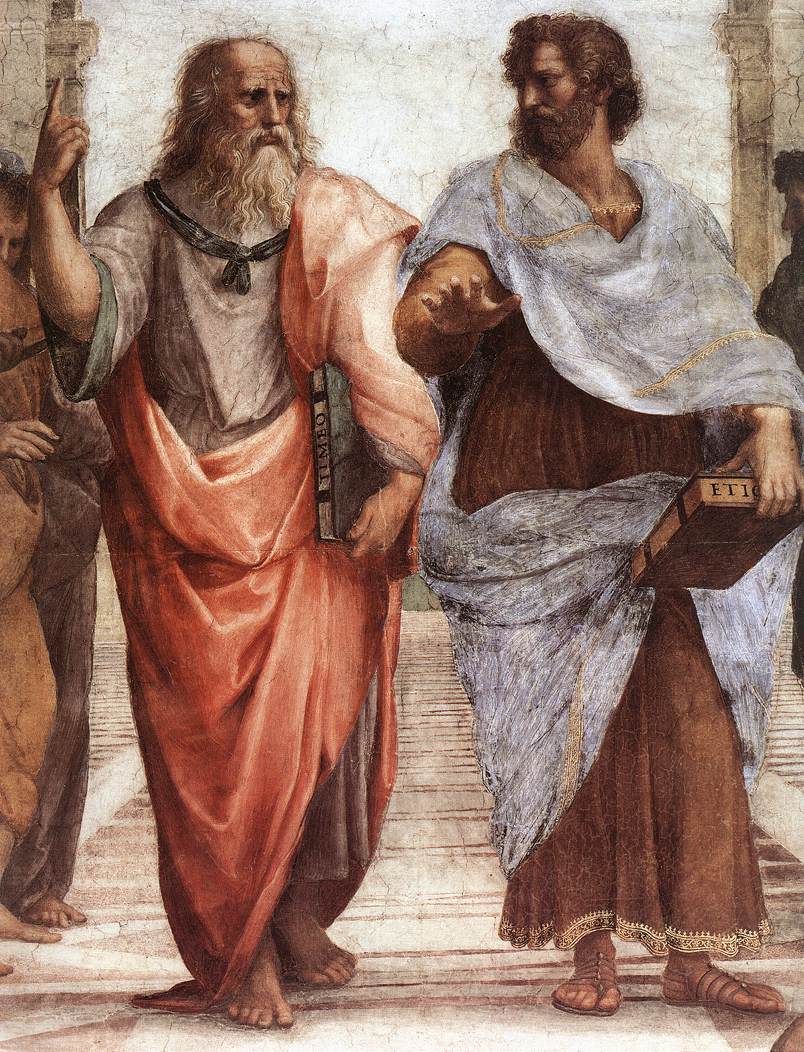
For Plato, sensible things are unstable and imperfect. Beautiful things become ugly, political arrangements decay, and apparently equal objects prove unequal under closer comparison. A drawn circle is never perfectly round, yet it seems to imitate a perfection that no physical drawing achieves. Knowledge in its strongest sense must therefore reach beyond changing appearances toward stable realities Plato called Forms: Beauty, Equality, Justice, the Good, and other intelligible standards by which particular things can be recognized and judged.
Learning, in this spirit, becomes partly recollection. Experience may awaken the mind to truths that sensation alone cannot supply. We see imperfect circles, yet somehow understand what perfect circularity would be. We compare unequal objects against an idea of equality that no sensible object fully embodies. The senses begin the process, but the intellect must rise beyond them.
Plato: A Transcendent Rational Realist
Plato may consequently be described as a Transcendent Rational Realist:
- Plato is a Realist because he believes that knowledge concerns realities which exist independently of the individual human mind.
- Plato is Rational because he believes that intellect gives us access to these realities. Acquiring knowledge is therefore closer to discovering or recollecting what already exists than creatively inventing it.
- Lastly, Plato is Transcendent because he believes that the highest objects of knowledge—the Forms—exist beyond the world directly perceived through the senses.
Taken together, Plato believes that the deepest truths belong to an intelligible realm beyond ordinary sensory experience. Human beings approach these truths primarily through intellectual reasoning, while sensory experience supplies only imperfect examples of them—or, in brief, Plato is a Transcendent Rational Realist.
Plato’s orientation has had both inspiring and dangerous descendants. The belief that visible reality is only an imperfect copy of a higher order has encouraged mathematics, theology, natural law, and the search for universal principles beneath appearances. It has also, at times, encouraged intellectual elites to distrust practical knowledge when it failed to fit a preferred abstract system. A beautiful theory can become difficult to abandon precisely because it seems more rational than the disorderly evidence contradicting it.
Aristotle rejected the separation of Forms from concrete things. The form of an oak or a horse exists within the living substance rather than in an independent realm. Knowledge begins with perception: repeated perceptions create memory, memories accumulate into experience, and intellect identifies universal patterns within them. Like Plato, Aristotle believes reality is intelligible, but he locates its explanatory principles within natural objects and processes.
Aristotle: An Immanent Empirical Realist
Aristotle may correspondingly be described as an Immanent Empirical Realist:
- Aristotle is a Realist because he believes that knowledge concerns a reality which exists independently of the individual human mind.
- Aristotle is Empirical because he believes that knowledge begins with sense-perception. Repeated observations become memories and experience, from which the intellect identifies more general truths.
- Lastly, Aristotle is Immanent because he believes that the forms and principles which make things intelligible exist within perceptible objects and processes, rather than in a separate realm beyond them.
Taken together, Aristotle believes that the deepest truths are found within the natural world. Human beings approach these truths by observing particular things and using intellect to identify the universal forms, causes, and principles operating within them—or, in brief, Aristotle is an Immanent Empirical Realist.
Their difference should not be reduced to rationalism against empiricism. Plato did not ignore experience, and Aristotle did not regard sensation as sufficient. Both asked what reality must be like for knowledge of it to be possible. Plato leaned more strongly toward reason and transcendence, while Aristotle leaned more strongly toward observation and immanence; nevertheless, both would appear broadly rationalist when compared with later empiricists.
Their shared assumption was that reality possessed an intelligible order available, at least in principle, to human understanding. The sharper modern shift occurred when philosophers began asking whether the mind could justify its claims about that order at all.
The Birth of the Empiricist Camp, and the Mind-Oriented Tradition
During the early modern period, philosophy increasingly turned from the question “What is reality like?” toward the prior question “What are human beings entitled to claim that they know about it?” Rationalists such as René Descartes and Gottfried Wilhelm Leibniz emphasized truths available through reason, while empiricists such as John Locke and David Hume treated experience as the source or material of our ideas. The division was not absolute: rationalists used experience and empiricists reasoned. Their disagreement concerned what each could legitimately supply.
David Hume brought this shift into focus through causality. When one billiard ball strikes another, we observe one movement followed by another, but we do not perceive a necessary bond passing between them. Experience shows regular succession; it does not logically prove that the sequence must continue. We expect bread to nourish us tomorrow because it has done so before, but this assumes that nature will remain sufficiently uniform. To defend induction by saying that it has worked before merely argues in a circle: it worked before, therefore it will work again.
Hume did not simply reject causality or advise human beings to stop reasoning causally. He argued that causal expectation arises through custom. Repeated sequences condition the mind to anticipate one event after another. Causal reasoning is indispensable, but the necessity we feel is not directly observed in the world. This explains both our practical success and our vulnerability to superstition, confirmation bias, and mistaken inference.
Hume: A Sceptical Empiricist
David Hume may consequently be described as a Sceptical Empiricist:
- Hume is an Empiricist because he believes that our ideas and knowledge originate in experience.
- Hume is Sceptical because experience reveals only that events regularly follow one another; it does not reveal or prove a necessary connection between them.
- Lastly, Hume is Habitualist about causality because he believes repeated experience conditions the mind to expect one event after another. Causal belief is therefore a practical habit rather than knowledge of an observable causal power.
Taken together, Hume believes that human beings cannot attain certain knowledge of necessary causal connections. We may improve our expectations through observation and experiment, but must remain aware that repeated patterns can reflect either genuine regularities or mistaken inference—or, in brief, Hume is a Sceptical Empiricist.
The practical consequence of Hume’s scepticism was not paralysis, but methodological caution. Modern control groups, repeated trials, statistical comparisons, and warnings that correlation does not imply causation all express a Humean suspicion: the mind is too quick to convert succession into necessity.
The histories of Ignaz Semmelweis and John Snow illustrate how this new attention to evidence could conflict with inherited theories. In the 1840s, Semmelweis observed that women giving birth in a Vienna clinic attended by physicians and medical students died from childbed fever at much higher rates than women in a clinic attended by midwives. Suspecting that doctors carried infectious material from autopsies to maternity patients, he introduced chlorinated handwashing and saw mortality fall dramatically.
The intervention worked before germ theory provided an accepted mechanism. Yet the medical establishment did not immediately absorb his conclusion. The reasons included Semmelweis’s presentation, professional conflict, institutional pride, and the absence of a theory explaining how invisible material transmitted disease. The episode shows the danger of demanding that effective evidence fit a pre-existing conceptual framework before practice is allowed to change. Theoretical intelligibility is valuable, but it becomes harmful when the absence of a complete explanation outweighs strong evidence that lives can be saved.
John Snow’s investigation of cholera in nineteenth-century London showed a more productive relationship between theory and experience. The prevailing miasmatic view associated disease with foul air, while Snow suspected contaminated water. He mapped deaths, investigated water sources, and examined apparent exceptions. His hypothesis guided which facts mattered, while the facts remained capable of correcting the hypothesis. Observation without theory is disorganized; theory without correction becomes a prison.
Immanuel Kant accepted Hume’s argument that causal necessity is not derived from experience, but rejected the idea that it is merely a learned habit. For Kant, causality is one of the categories through which experience becomes an ordered experience of objective events. Sensation supplies material, but the mind supplies organizing forms. We do not first experience a chaotic world and later learn causality; without causal organization, we could not experience an objective sequence of events in the first place.
Kant called his position transcendental idealism. “Idealism” here does not mean that the world is merely imaginary. It means that what we can know is always shaped by the conditions under which the human mind experiences it. “Transcendental” refers to the structures that make experience possible, rather than to objects beyond experience. Space, time, and causality do not arrive as ordinary objects perceived among other objects; they help form the framework within which objects can appear to us at all.
Kant therefore distinguished the phenomenal world, reality as it appears under the conditions of human cognition, from things in themselves, or noumena, reality considered independently of those conditions. We can possess objective knowledge within experience, but cannot step outside our mode of cognition and compare appearances with reality as it exists apart from us.
Kant: A Transcendental Idealist
Immanuel Kant may correspondingly be described as a Transcendental Idealist:
- Kant is an Idealist because he believes that the world as we experience it is partly shaped by structures supplied by the human mind.
- Kant is Transcendental because he investigates the conditions that must already be present for coherent experience and knowledge to be possible.
- Lastly, Kant is an Apriorist about causality because he believes that causality is not learned from experience but is a necessary category through which the mind organizes events.
Taken together, Kant believes that knowledge arises through an interaction between sensory experience and the mind’s organizing framework. Causality necessarily governs the phenomenal world—the world as it appears to us—but cannot automatically be attributed to reality as it exists independently of human cognition—or, in brief, Kant is a Transcendental Idealist.
Hume and Kant can be compressed into a reversal: for Hume, repeated experience produces causal expectation; for Kant, the category of causality helps make objective experience possible. Hume emphasizes what experience builds into the mind. Kant emphasizes what the mind must already contribute to experience.
The earlier world-oriented tradition asked what principles in reality make things happen. The modern mind-oriented tradition asked what allows human beings to experience and justify causal order. Later philosophy would attempt to reconnect the two.
Kant’s insight also foreshadowed a modern problem: institutions do not merely record reality; they organize it through categories. A census category, a medical diagnosis, a school grade, or an economic variable does not simply reflect what is already there. It selects, separates, and renders some features visible while leaving others obscure. Categories are necessary for knowledge, but they can harden into realities of their own.
Population records illustrate this duality. Censuses and mortality registers allow governments to detect epidemics, locate poverty, compare infant mortality, and convert separate private tragedies into visible social patterns. Without aggregation, much suffering remains unseen. Yet the same records can facilitate taxation, conscription, surveillance, discrimination, and forced removal. To be counted is to become visible to care, but also visible to power. The Kantian lesson is not that categories are arbitrary, but that they shape the world available to institutional action.
The Modern Merging and Scattering of the Camps
After Hume and Kant, the debate no longer remained a conflict between two stable camps. It scattered into several traditions, each attempting to preserve part of the older insights while correcting their weaknesses.
John Stuart Mill developed methods for comparing cases and identifying regularities: where a suspected cause was present, where it was absent, and how outcomes differed. This strengthened experimental science by directing attention away from speculative powers and toward controlled comparison. Yet regularity alone remained insufficient. Two events may repeatedly occur together because both arise from a third cause. The rooster and the sunrise are regularly associated, but the sequence contains no causal production.
Positivists later argued that meaningful knowledge should remain closely tied to possible observation and testing. This helped expose vague metaphysical claims and demanded clarity from scientific language. Positivism’s strength was its refusal to allow eloquence to substitute for evidence. Its weakness appeared when what could not yet be measured was treated as meaningless or unreal. Observation is never entirely neutral: instruments, concepts, and theories determine which features of reality become visible and which questions are asked.
Modern physics further unsettled the traditional picture. Einstein’s theory of relativity connected possible causal influence to the structure of spacetime rather than to a universal cosmic clock. Quantum mechanics weakened the equation of causality with determinism: a cause may alter the probability of an outcome without making it inevitable. Smoking causes cancer even though many smokers do not develop it; a virus may cause illness without producing symptoms in every exposed person.
This encouraged probabilistic accounts of causation, but probability-raising alone was not enough. Severely ill patients receive stronger treatments, so treatment may correlate with poor outcomes even when it helps. Causal judgment requires attention to selection, common causes, timing, and alternative explanations.
Karl Popper responded to the difficulty of proving theories by emphasizing falsification. Science advances not merely by collecting examples that agree with a theory, but by formulating claims that risk being shown wrong. A thousand white swans cannot establish with certainty that all swans are white, while one black swan can refute the universal statement.
Popper’s method directly opposes confirmation bias. Peter Wason’s “2-4-6” experiment later showed how readily people search for examples supporting a hypothesis rather than cases capable of disproving it. Falsification attempts to institutionalize humility: a good theory must expose itself to failure.
Thomas Kuhn complicated this picture by observing that scientists work within paradigms: inherited frameworks of concepts, instruments, standards, and exemplary solutions. Paradigms make research possible by telling investigators what counts as a relevant question, a legitimate method, and a satisfactory answer. Yet the same framework can render anomalies invisible. The conceptual structure that enables knowledge may delay recognition of what it excludes.
Lysenkoism in the Soviet Union demonstrates what happens when a paradigm becomes protected by political authority. Trofim Lysenko rejected central elements of genetics and promoted biological claims compatible with the ideological expectations of the regime. Geneticists were dismissed, silenced, imprisoned, or otherwise excluded. The central failure was not merely the adoption of an incorrect theory, but the destruction of the mechanisms through which incorrect theories are revised. Once disagreement became disloyalty, error gained political protection.
The example reveals that knowledge depends not only upon the intelligence of individual thinkers, but upon institutions that permit prevailing theories to encounter inconvenient evidence. A society may possess laboratories, measurements, and technical language while remaining epistemologically closed.
Modern causal theories also moved beyond simple regularity. Counterfactual reasoning asks whether an effect would have occurred had the suspected cause been absent. A stone caused a window to break if, under relevant conditions, the window would not otherwise have broken.
Interventionism develops this idea further: (X) causes (Y) when deliberately changing (X), under suitable conditions, changes (Y). Randomized medical trials embody this logic by separating treatment from the ordinary reasons why some patients receive it. Observing that sick patients take more medicine cannot tell us whether medicine makes them sick; intervention attempts to isolate the treatment from the factors that selected them into treatment.
Structural causal models now represent assumptions about causes through networks of variables. They distinguish direct effects, common causes, and intermediate pathways, while estimating what might happen under intervention. Yet no model extracts causality mechanically from data. Its arrows depend upon substantive assumptions about how the world works. Mathematics can make reasoning explicit; it cannot remove the need for judgment.
Mechanistic accounts supply another dimension. A clinical trial may show that a drug works, while biology explains how it acts through receptors, chemical processes, and physiological pathways. Modern causal knowledge often combines difference-making with mechanism: whether changing something affects an outcome, and how the effect is produced.
This growing faith in measurement, formalization, and controllable systems also reshaped institutions far beyond science.
Frederick Winslow Taylor’s scientific management divided labour into measurable motions, timed them, and reconstructed work through standardized procedures. Taylorism could expose inefficient tools, wasted movement, and arbitrary production practices. Yet it also transferred authority from workers to managers. Tacit craft knowledge, judgment, fatigue, cooperation, pride, and meaning were difficult to measure and therefore easy to discount. The worker became an executor of instructions rather than a possessor of knowledge.
The epistemological problem was not measurement itself, but the assumption that everything relevant could be observed from outside and converted into a procedure. Taylorism later entered warehouses, hospitals, call centres, schools, public administration, and digital platforms. Performance dashboards and algorithmic schedules continue its belief that what matters can be represented through measurable output. The stopwatch may eventually become internalized, with individuals optimizing exercise, education, friendship, and leisure as if managing a factory.
The American conduct of the Vietnam War shows how quantification can become detached from the reality it represents. In a war lacking stable front lines, body counts and casualty ratios became measures of progress. The numbers were difficult to verify and created incentives for exaggeration and misclassification. A struggle involving legitimacy, nationalism, fear, and allegiance was compressed into countable deaths.
The problem was not the use of data. Without measurement, governments become vulnerable to intuition, propaganda, and wishful thinking. The failure was treating measurable variables as exhaustive descriptions of reality. Once careers and strategy depended upon improving a metric, the metric began to reorganize behaviour. The map ceased merely to describe the territory and began to distort it.
Financialisation repeats this pattern at the level of corporations and markets. Finance makes uncertain futures comparable by translating them into present monetary values. This enables investment, pensions, lending, and risk management. Yet when shareholder returns become the dominant measure of institutional success, the financial representation may displace the institution itself.
A factory sustaining a community and preserving technical skill may appear inefficient when its financial return falls below an alternative investment. A balance sheet records wages as costs but struggles to record the knowledge created by stable employment, the trust accumulated in a community, or the technical capacity that might matter decades later. Price is useful knowledge, but not a complete theory of value.
The same narrowing occurs culturally when education becomes “human capital,” friendship becomes a “network,” and sleep becomes a productivity input. Investment language reveals genuine trade-offs, but it may make activities pursued for their own sake difficult to justify. An epistemology designed for comparing financial projects gradually becomes a general philosophy of life.
Communist planning and capitalist markets embody rival epistemologies of economic knowledge. Central planning attempts to represent society from above and direct resources toward collective priorities. It can coordinate major projects and concentrate investment rapidly, but struggles with dispersed local knowledge, changing preferences, and qualities that simplified production targets fail to capture. Factories may fulfil quotas by producing heavier objects when measured by weight, or excessive quantities of unusable objects when measured by number. The institution learns to produce what its categories reward.
Markets aggregate decentralized decisions through prices without requiring one planner to understand the whole economy. Yet they register effective demand—desire supported by purchasing power—rather than need as such. A luxury desired by the wealthy may generate a stronger signal than medicine needed by those unable to pay. Planning risks losing local knowledge; markets risk overlooking needs that generate no profitable demand.
Neither system merely discovers value. Each institutionalizes assumptions about which evidence of value should govern production.
Education reproduces the older epistemological divide. Instructional models assume that knowledge can be organized in advance and transmitted through carefully designed steps. This efficiently teaches inherited skills, but may reduce learning to producing expected responses. Experiential education emphasizes inquiry, action, reflection, and reconstruction through experience. It preserves agency, but can leave students to rediscover what clear instruction could have supplied. Instruction provides inherited maps; experience teaches how maps relate to terrain.
Pure and applied science form a similar pair. A society funding only immediately useful research may sacrifice discoveries whose applications cannot yet be imagined. A culture honouring only abstract theory may neglect engineering, replication, maintenance, and the difficult work of making ideas function under real conditions. Pure science preserves unrealized possibility; applied science confronts friction, scale, and present human need.
Modernity therefore did not resolve the conflict between reason and experience. It multiplied their combinations.
The Emerging Self-Awareness of the Camp’s: A Lesson of Pluralism and Peace
The historical examples share one lesson: every way of knowing has a characteristic remainder, something real that its preferred method has difficulty recognizing.
Platonism sees intelligible order but may undervalue disorderly experience. Aristotelian realism sees mechanisms within nature but may preserve inherited categories too confidently. Empiricism disciplines speculation but can mistake what is measurable for all that is real. Rationalism organizes experience but can protect elegant systems from inconvenient evidence. Kantian thought reveals how categories shape perception, but may encourage excessive attention to frameworks at the expense of the world resisting them. Falsification protects against confirmation bias, yet scientific theories are rarely tested one assumption at a time. Paradigms make knowledge possible, yet can hide anomalies. Statistics reveals large-scale patterns but strips away context. Qualitative understanding restores context but struggles to compare millions of cases.
Taylorism sees time and output but misses tacit skill and meaning. Financialisation sees monetary value but may hide social, ecological, and long-term value. Planning sees collective priorities but loses dispersed knowledge. Markets see demand but overlook need without purchasing power. Population records reveal aggregate suffering but threaten privacy and individuality. Instruction reveals specified mastery but may neglect curiosity and judgment. Experience preserves agency but cannot transmit the whole inheritance of knowledge unaided.
Neither side should conquer the other. Each should correct the other’s blindness.
Knowledge is therefore best understood as a system of correctives. Experience restrains speculation; reason organizes experience. Scepticism tests confidence; realism reminds us that the world resists our categories. Kantian reflection reminds us that evidence does not arrive without categories. Statistics reveals patterns invisible in individual stories; testimony restores the person hidden inside the average. Counterfactual reasoning asks what difference a cause made; mechanisms explain how the difference occurred. Historical understanding returns context to general models, while experiments test whether contextual stories survive controlled comparison.
This pluralism does not mean that every theory is equally valid. Some claims are false, some methods are stronger than others, and some traditions survive only because institutions protect them from criticism. Pluralism is not the refusal to judge. It is the recognition that responsible judgment often requires several forms of evidence.
A medical trial may show that a treatment works on average. A biological mechanism may explain why. Clinical judgment may determine whether the trial population resembles the patient in front of the physician. Patient testimony may reveal an outcome the trial failed to measure. None of these sources is sufficient in every case, but together they make error more difficult to preserve.
The reliability of knowledge therefore depends not only upon intelligent individuals, but upon institutions capable of noticing what their dominant method leaves outside the frame.
A World Built on Ideas—Made Visible Through Narrative and Story
The history of philosophy is not a museum of obsolete opinions. Its ideas have entered the institutions through which modern life is organized. Whenever we trust measurement, we inherit empiricism. Whenever we search for principles beneath appearances, we inherit rationalism. Whenever we believe inquiry can reveal structures independent of us, we inherit realism. Whenever we ask how concepts shape observation, we inherit Kantian idealism or constructivism. Whenever we compare an actual event with what might otherwise have happened, we reason counterfactually. Whenever we change one variable to observe another, we practise interventionism. Whenever we trace the process connecting them, we search for mechanisms.
Most people carry several traditions at once. A scientist may be empiricist in method, realist about particles, rationalist about mathematics, and Kantian about conceptual frameworks. A manager may demand quantitative evidence while trusting an unmeasured intuition about strategy. A voter may reject causal claims from opponents while accepting equally weak claims from allies. Philosophical camps divide not only societies but individual minds.
Their history matters because every act assumes something about knowledge. To cross a bridge is to trust causal understanding. To take medicine is to trust inference from evidence. To vote for a policy is to believe that certain actions will produce preferable consequences. To reject a rumour is to apply an implicit theory of testimony and justification.
The unraveling of this philosophical inheritance may be the closest we come to epiphany—or it may become another exercise in confirmation bias, as circular as the reasoning exposed by Wason’s “2-4-6” problem. Apophenia and epiphany still tile the floor beneath us. Modern methods do not tell us in advance which tile hides treasure and which conceals a trapdoor. They allow us to test the surface, compare observations, invite criticism, and revise the map when it fails.
The central question is therefore not whether certainty can be achieved, but how beings with fallible senses, inherited concepts, habitual expectations, social incentives, and limited perspectives can learn enough about cause and effect to act wisely.
It may be that no individual will ever see completely past the illusions fabricated by their own mind—not even if they become as Cartesian and solipsistic as Descartes, doubting everything except the thoughts immediately present to consciousness. Yet perhaps people can see further together.
One mind may mistake a swaying branch for a waving hand. Several minds can compare their positions, approach from different directions, and discover whether anyone is there. One observer finds a pattern; another tests it; a third proposes an alternative explanation; a fourth repeats the experiment. Individually gathered knowledge enters a shared pool, where some illusions are flattened and some patterns strengthened.
Consensus alone does not guarantee truth. Ten people can share the same prejudice, incentive, or conceptual blind spot. Yet organized communication makes correction possible. Scientific institutions, archives, public debate, adversarial courts, and peer review are imperfect attempts to make minds correct one another.
Through such communication, we may act as one another’s night-lights, exposing the monsters imagined beneath separate beds. A companion’s response—“What makes you think a Minotaur would care for your stinking feet?”—may be enough to interrupt the spell.
Knowledge becomes a social inheritance: concepts, instruments, records, and institutions passed between generations and corrected imperfectly along the way. A philosophical idea can shape people who have never read its author. Hume survives in experimental caution, Kant in the recognition that observation is organized by concepts, Aristotle in mechanistic explanation, and Plato whenever inquiry searches for a stable order beneath appearances.
The dead do not rule the living only through commandments. They also rule through concepts whose origins the living have forgotten. Every writer has a reason for writing, and there are many inks in which a world may be recorded. I happen to prefer blue.
So I welcome you to my world: a world crowded with memories, objects, abstractions, and inherited perspectives. Its apparent disorder may conceal a pattern, or the pattern may be one I have placed there myself. We will have to discover which.
I hope you will gain something from my memory.
I believe you will.
The dialogue has been requested with the conductor;
To whom it may concern,
The Second of the Primary Colours,
The Father; the Narrator in BLUE
{
( P.S – This post was written with the assistance of AI )
Leave a Reply