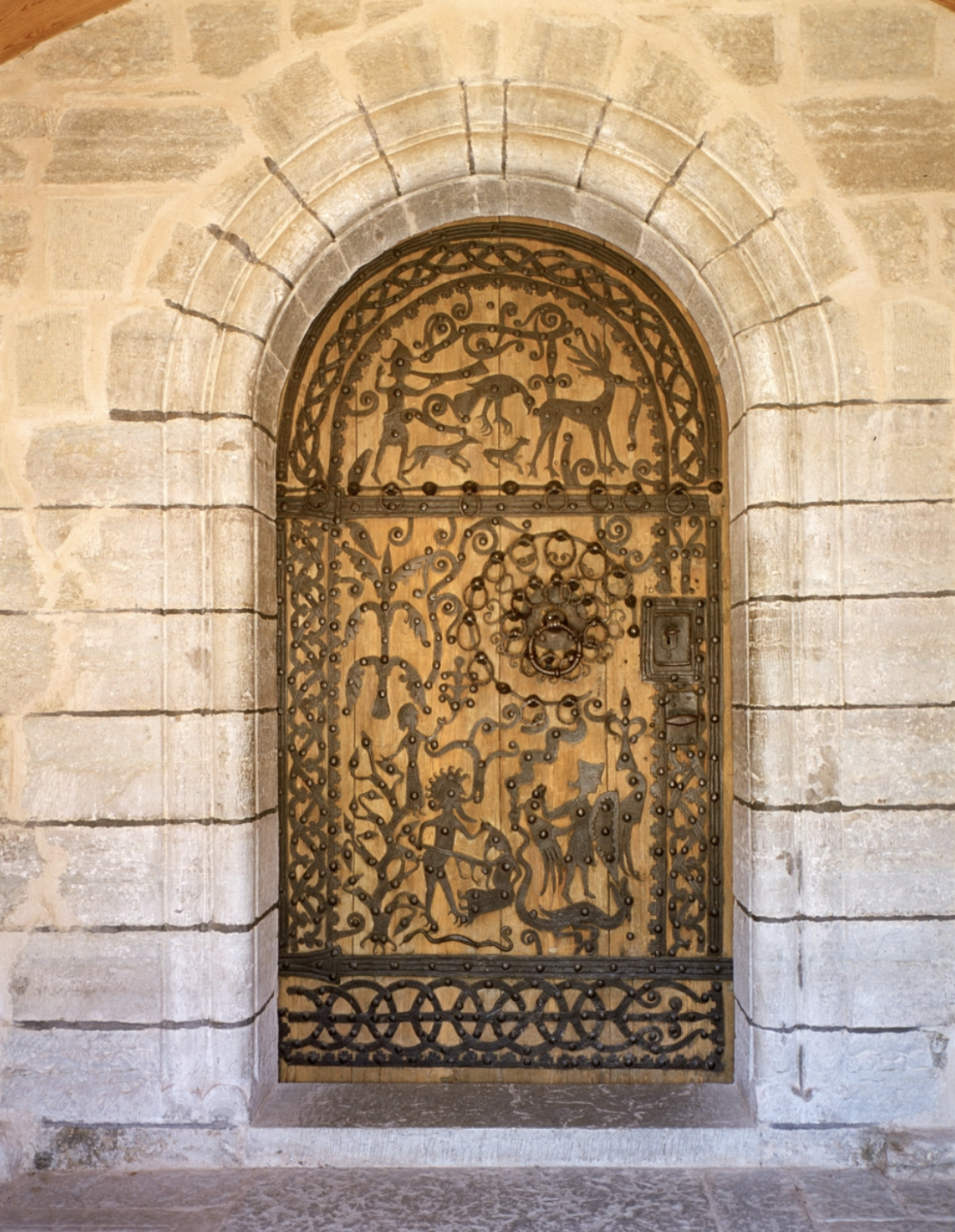
At the heart of the 13th-century Rogslösa Church in Sweden stands the Rogslösa Door, a medieval masterpiece crafted around 1275 by the “Rogslösa Master.” Its ironwork serves as both strength and a magical barrier against spirits, featuring scenes of the Fall of Man, Archangel Michael’s battle, and a hunting scene linked to Saint Eustachius.
Source : https://www.svd.se/a/14nXX/var-finns-sveriges-mest-fantastiska-dorr
Image Source: https://digitaltmuseum.se/021016419730/rogslosadorren
Samuel’s soul had an insatiable appetite for being somewhere else. Consequently, it recognized any means of entering or exiting that somewhere. This often translated into an acute awareness of doors—wherever he roamed. Samuel fixated on the details of those doors that facilitated passage: the minute particulars of handles and locks. He firmly believed that their iron levers were the primary mechanisms of release to life’s myriad riddles. Suddenly, there it stood before him—his own front door. Without hesitation, Samuel reached for the knob, pivoting through the portal from A to B and stepping into the City Garden.
As he crossed the threshold, a light rain struck his face at an unexpected angle, rendering him momentarily frozen. The branches of nearby trees shook their leaves, akin to a dog drying off after a bath; one could easily assume that Samuel’s stillness stemmed from discomfort rather than the tempestuous confusion swirling within his mind. What had compelled him to open this door? Teleologically speaking, he didn’t just open doors; he opened them for something, a future goal like a magnet attracting iron filings, though the specific nature of that final cause evaded him.
Samuel shared a certain philosophical affinity with Aristotle. Despite his limited knowledge of the ancient thinker—often confusing him with Socrates or Plato—he resonated with Aristotle’s model for understanding actions and events, articulated through the Four Causes. Each threshold crossed, to him, represented a result of these causes, a framework he would invoke to tackle the question of why he had opened the door. The Causa Materialis encompassed the physical matter of his body and the door itself; without it, no crossing was possible. The Causa Formalis represented the specific arrangement of matter, giving rise to the “Samuel-shape” and the “door-shape.” The Causa Efficiens was the spark of decision, the mechanical energy igniting the latch. Finally, the Causa Finalis pointed to the ultimate purpose behind placing his body and mind in a new environment.
According to the Four Causes, it was the final cause—an outcome—that propelled all other causes. As the rain trickled onto his face, Samuel perceived Final Causes operating in the natural world around him. The rain became a material entity, shaped by solar heat and atmospheric cooling, fulfilling its Causa Finalis as a vessel of fresh water for all life, now including him. Similarly, the leaves on a plant existed with the Causa Finalis of producing nourishment. This understanding implied that it was the result determining the action rather than the action yielding the result. Samuel’s exploration was guided by this final cause, the prime mover among four equals in his toolkit for comprehending the universe.
Standing amidst the manicured beauty of the City Garden, Samuel was unaware that he was steeped in a philosophical heritage intricately intertwined with Christian theology. The contours of his thought had taken shape long before his own reflections began; the concepts he believed to be self-derived were, in truth, sedimented through centuries of transmission, reaching from antiquity into the modern intellectual sphere he occupied. Embracing a realist perspective, he affirmed the existence of universals—attributes shared across multiple particulars—while interpreting human and natural phenomena through the lens of Aristotelian teleology.
Within the Christian narrative of Genesis, realism acquired a theological significance. Universals were understood as forms birthed from the creativity of the Logos, the divine reason permeating existence. Creation unfolded through a series of distinctions—light from darkness, land from water—constructing reality through clear categories that enhanced one’s understanding. For Samuel, a white City Park oak sought the sky not merely as a conglomerate of materials, like bark and chlorophyll, but as a representation of a form transcending its mere specifics, resonating with the realist notion of the “Tree of Knowledge,” a universal concept existing in the divine mind prior to designation. In this context, the garden was not simply a physical space but a metaphysical realm, filled with entities whose essence had been known before their identification.
“Sure,” Samuel mused. The rationale for opening the door could be the realization of his choice to traverse from A to B; yet, what accounted for that choice? What incited him to alter his environment? To uncover the “why,” he recognized he must first understand his destination. As the rain intensified, he found himself paralyzed by this query. Had he left his shelter merely to face the downpour, carried by the cloud-bearer known as ‘Zeus Ombrius’? Samuel entertained several theories: perhaps he was journeying to work, spotting an opportunity; maybe he sought peace and serenity; or was he, perhaps, yearning for something new, craving variety, and freedom? Uncertainty pervaded his thoughts.
Was it the necessity of work—seizing opportunity—that drove him through the door? Faced with the dilemma of leisure versus work, one ultimately negotiates the balance between negative freedom, characterized by absence of responsibility at the cost of less, and positive freedom, which entails having more yet invites responsibility. Engagement in work often stems from an innate sense of duty, igniting a motivation within individuals like Samuel to pursue opportunities that foster not only personal growth but also contribute to societal flourishing. With an understanding that capital depreciates approximately 8% annually and inflation rises by about 2% each year, the economic implications of avoiding work become apparent; nations thrive on the productivity of their workforce, and without this exchange of effort, resources dwindle. Thus, it is reasonable to suggest that this necessity nudged Samuel through the door.
Alternately, if work was not his motivation, perhaps it was the allure of leisure found in peace and serenity. The prospect of a soothing walk or meditation might have beckoned him towards the door, offering a chance for self-reflection against life’s chaos. Should Samuel’s Causa Finalis embody a monastic renunciation of worldly pursuits, his intent would lean toward spiritual goals defined by seclusion and disciplined shielding of the mind from distraction. However, a broad acceptance of such a lifestyle could endanger societal vitality, provoking scarcity due to diminished productivity; as Kant’s Categorical Imperative proposes, if many pursued this path, community viability risks disintegration. Thus, it seemed statistically implausible that Samuel’s motivation stemmed from this desire.
As he walked the gravel path toward the City, he became aware of a subtle yet persistent tension rising with the mud that crept up his pant legs. This tension was not solely physical; it was conceptual, as though each stain disrupted an internal order he unconsciously imposed upon the surroundings. The park, once perceived as a harmonious whole, began to disintegrate beneath the weight of distinctions he started to extract during his walk toward the City. These distinctions, akin to an Adamic act of naming—after Adam from Eden, tasked with naming all creatures—sparked a realization. What if he were to suspend his attachment to the realist conception of the City Garden and instead adopt a nominalist viewpoint? Instead of fixating on universals (like the beauty of the Garden), he could focus on irreducible particulars, each entity uniquely manifesting in that moment, much like the mud blotches on his pant legs. As the rain fell, the distinctions between the Garden and the City blurred, presenting an increasingly challenging barrier to discern.
Contemplating doubts regarding his realist ontological beliefs, Samuel turned to the foundations of his convictions to ascertain whether they necessitated a nominalist revision. His adherence to realism stemmed from an Aristotelian teleological belief—that the world operated according to divine laws. If Samuel could confirm or reverse the existence of a God-creator, he could determine whether to embrace a divinely inspired realism or a God-defying nominalism. A compelling reason to believe in God arose in contemplating the initiation of existence. If not an external being, such as a God, who initiated all? Furthermore, a God, if existent, would have fashioned all entities—including Samuel—toward good rather than bad actions; thus, Samuel’s opening of the door represented a step toward something inherently good. This belief implied that “if an all-powerful being existed, envisioning it as benevolent enough to produce an optimal world was reasonable.” However, knowledge of such a being might also remain eternally inaccessible, as it was theorized to be the primary cause of everything else, the first exists in unity and thus eludes understanding.
Pausing before a small brass plaque identifying a nearby tree species at the border between the City Park and the City, Samuel recognized the gravity of this inherited gesture: he was both observer and classifier, a nominalist surveyor segmenting the ostensibly sacred continuity of the natural world into digestible linguistic partitions. He perceived the park to harbor a primordial coherence—a “goodness” that transcended recognition—but it became a “park” only through acts of delimitation: naming, bordering, and conceptual framing. Thus, he resided as a sub-creator in a borrowed Eden, caught amid the silent, generative Logos of the garden and the restless, finite vocabulary enabling navigation through it. The distinction crystallized: the Logos embodied a fundamental intelligibility woven into the fabric of being, while his lexicon was an artificial yet vital scaffold—provisional, ontologically superficial yet necessary for human orientation within the world.
As Samuel journeyed along the path, he shifted from the ordered plenitude of Genesis to the fractured domain of Babel. Here, unity dissolved into a proliferation of names, clarity faded into a dense thicket of particulars. The asphalt beneath his feet transformed, not as an instantiation of a universal but as a product of human intention and utility. Constructs like “Street,” “Tax Zone,” and “Property Line” emerged as entities devoid of independent ontological status, borne solely from shared language. While the Garden had been shaped by the Logos, the City appeared molded by Nomina. Immersed in this artificial environment, Samuel perceived the expansion of human freedom as intrinsically linked to the reliance upon linguistic scaffolding. The buildings surrounding him—defined as “Bank,” “Post Office,” “Office,” or “Residence”—derived their essence from the names and functions conferred upon them. Inhabitants existed solely in relation to these forced identities; should they vanish, these entities would revert to indistinct arrangements, their very existence reliant on continuous acts of recognition. Thus, the City emerged as a vast edifice of coordinated naming sustained by collective belief, revealing a disquieting truth: while the Garden expressed a world whose intelligibility predated him, the City confronted him with one dependent on myriad human acts of designation.
Samuel struggled to dissect the factors influencing his actions, grappling with whether he pursued a better life or was simply escaping human anxieties—a quest further complicated by the awareness that, although landscapes transform, the “self” bears an inescapable burden. Perhaps his reasoning was not fundamentally flawed but instead ensnared within the Four Causes’ Aristotelian framework, leading him astray. What if a dualistic perspective—where positive and negative forces coalesce—might more vividly illuminate his motivations for continuing onward into the City’s dynamic vibrancy? This contemplation nudged him to search foundational beliefs, awakening the lurking presence of Francis Bacon’s Four Idols of the Mind: the Idols of the Tribe, Cave, Marketplace, and Theatre—barriers obscuring his clarity. Casting aside the Causa Finalis and Teleologia from his initial reasoning liberated him, allowing his understanding of reality to dance in harmony with the arrow of time. In this newly acquired state, the present began to interpret the past rather than bend to a predestined future, further emboldened by the dismissal of the Causa Formalis, which granted newfound adaptability to his reasoning. This shift permitted explanations to evolve, coalescing around the very nature they aimed to illuminate, leading to a deeper comprehension reflective of his expanding intellect.
Samuel’s philosophical evolution embraced the fluid forms of nature, illuminated through evolving principles like evolution and scientific phenomena. This newfound understanding opened corridors of clarity as he ventured deeper into the City, where a new dynamic form of reasoning emerged—akin to a mathematics of variables, suffused with infinite flexibility in their equations. Transitioning from a staunch belief in universals to a perspective grounded in particulars, he moved from Realism to Nominalism, witnessing the foundation of his worldview tremble, the Garden he had once cherished crumbling into rubble, unveiling a clear view of the burgeoning City. With the “brake pad” of teleology removed, a vibrant construction site emerged from the ashes of his former beliefs, converting Causa Materialis into material science and Causa Efficiens into the principle of causality—‘cause and effect.’ As he related to the world independent of externals dictated by divine purpose, Samuel found himself existing and acting simply because he was. This newfound freedom compelled him to traverse a multitude of doors, relinquishing his realist ideals to accommodate his burgeoning nominalist outlook.
Yet, as he explored deeper historical and existential dimensions, Samuel could not escape reflections on the narrative of Adam and Eve in the Garden of Eden. Their transformative act of engaging with the Tree of Knowledge not only imparted information but also radically altered their perception of existence and reality. With discernment came both a profound gift and the burden of consciousness, sowing seeds of anxiety alongside newfound freedom. This pivotal moment signified a profound transition, and as Samuel continued along his path, he sensed an uncanny parallel between the City’s intricate geometry and the challenges Adam and Eve would later confront. Their own journey from simplistic realism towards a more complex nominalist realization provoked an unsettling awareness of autonomy—human activity now manifesting not in fixed destinations but in a ceaseless odyssey between choices and states of being.
The modern condition, post-industrialization, flipped this narrative, dramatically expanding life’s parameters. Cities thrived, professions diversified, and this mobility invited a broader spectrum of self-definition. By the twentieth century, individuals faced a landscape demanding relentless decision-making—not solely about actions but identities themselves. As freedom organized itself into new forms, anxiety proliferated; the expansive openness of possibilities, void of stabilizing confines, anchored humanity in a state of existential questioning and uncertainty. The blissful ignorance of Eden had been supplanted by a profound tapestry of choices, with Samuel feeling the weight of that burden as he wandered through the intricate labyrinth of the City, his journey perpetually shaped by the lingering influence of Bacon’s Idols, reminding him that clarity is often obscured by the very constructs he sought to navigate.
Perhaps some third hypothesis existed that universally explained why Samuel—and doors in general—seemed to beckon. What if Samuel’s Causa Finalis revolved around a desire for a change in environment? This change could motivate his movement through doors, whether he moved to work to seize opportunity or avoided it to find tranquility. Perhaps it was the process of travel itself that constituted the Final Cause prompting Samuel to open doors; being rooted in a lifestyle of choices demanded decision-making—the trade-off of A for B. Maybe then, liberty—the ability to choose—was what truly impelled his movements. However, if an increase in choice equated to greater freedom, wouldn’t it suggest that the attainment of maximal freedom required the acceptance of severe decision anxiety? Yet, if one felt anxious, making the decision to open the door became implausible. This possibility could not represent the Causa Finalis behind Samuel’s action either.
Thus, if it was not his inclination toward work—a search for pain—or being deterred toward leisure—a means of avoiding pain—nor a quest for variety through change—drawn to the interplay of pain and pleasure—what, then, was the Final Cause that ushered Samuel into the rain? Burdened by these inquiries, Samuel began to navigate the labyrinth of the City. Underneath the chaotic urban infrastructure, his discomfort intensified—not just as a byproduct of radical freedom, but as an outcome of the complexities that entwined him. Proliferating bureaucratic systems branched endlessly, pathways meandered without conclusion, and meaning slipped away with every grasp he attempted. The City paradoxically liberated humanity from nature’s stringent confines while entrapping individuals within intricate webs of abstraction. As he continued on, he recognized that the burdens he bore extended beyond personal choices, belonging instead to an environment rife with convoluted systems often beyond comprehension.
Amid these reflections, fragments of his former beliefs clawed at him. Had his swift embrace of a nominalist worldview led to the dissolution of a realist belief in teaching by example? Was there an intrinsic value in goodness transcending personal ramifications? This tension unveiled a haunting reality: without a realist foundation for morality, he feared moral permissiveness. Humanity’s intrinsic nature might require the retention of certain realist ideals; the shared consciousness—the cumulative symbols, expressions, and actions carrying historical weight—touched nostalgia, propelling him towards the understanding that morality, while potentially subjective, remained undeniably woven into social constructs. This perspective urged him to consider morality functioning akin to an automatic collision-avoidance system—not dependent on belief in its existence, but rather as an intrinsic mechanism guiding behavior through the web of cause and effect.
As Samuel advanced, he sensed a resurgence of realist ideals, tethered to the invaluable exercise of building trust—an endeavour necessitating higher ideals to motivate collective work. He perceived the City as a labyrinth that had initially ensnared him in idealism, with God guiding him, only to become enveloped in existentialism where Precision now steered him. He began to ponder whether beauty in art—held together by gemeinschaft-defined realist beauty versus introspective nominalist beauty—might forge a bridge between his conflicting preferences. Straddling these two philosophical frameworks, Samuel acknowledged the paradox splitting his essence, recognizing the oscillation of human civilization between rationality and myth. Ancient figures like Hekate, guardians of transitions, lingered in his thoughts, reminding him that the significance of thresholds transcended mere physicality.
Samuel’s journey replicated the struggle seen in thinkers like Schopenhauer and Nietzsche, wrestling with whether desire was fundamental to suffering or if peace could emerge from renunciation instead of expansion. In this contemplation, he found solace within the synthesis of his experiences—not a rejection of one philosophical vein over another, but rather a compromise reflecting the encompassing chaos of existence. With the City as his labyrinth, guided by both idealism and existential mechanics, Samuel stood at the intersection of profound philosophical inquiries. Throughout his odyssey, his perspective shifted—illuminating a transition from passive observation to active engagement with the world. He recognized the historical evolution of thought as science transformed from rigid doctrines into a dynamic, evolving methodology. Samuel comprehended the metamorphosis from mere description of nature to its prediction and manipulation, revealed through statistical models and standardized testing.
As he journeyed through the City, the implications of these philosophical distinctions resonated deeply within him—from foundational debates of hedonism and the pursuit of genuine happiness to contrasts between free will and mechanistic behavior. Even amid historical entanglements, echoes of truths persisted. Though exhaustion loomed and uncertainty pressed upon him, Samuel learned to embrace the complexities of his path. Accepting motion, he recognized that it drew him not closer to a singular truth secured behind a closed door but through variable thresholds—a practice of disciplined existence, finding joy in the act of living. With newfound resolve, he reached for another door handle, steeled by the wisdom gathered along the way. Rather than stagnation in reflection, Samuel chose to venture deeper into the labyrinth, buoyed by the understanding that each choice unlocked new avenues of insight into his place within the intricate dance of existence.
– Albert Adlersson (and A.I), 10 May 2026
Leave a Reply